Tag copyright

Are you certain about that uncertainty?

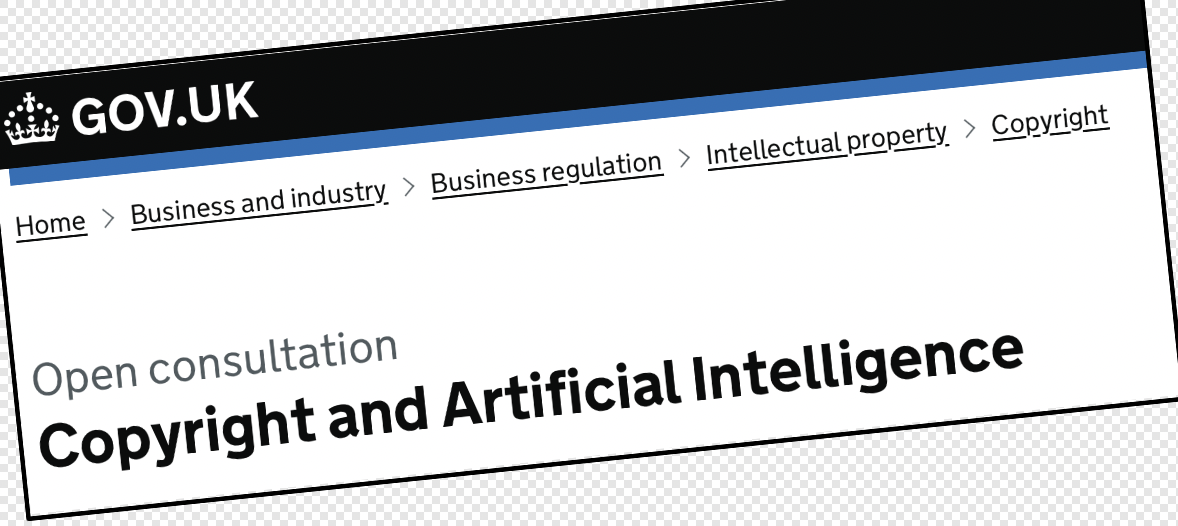
A screenshot of a clause from the UK consultation on AI and copyright which explicitly states that AI training requires permission

The UK government’s consultation on AI and copyright is prefaced by an un-named minister. In it they say that copyright law related to AI is “uncertain”. Removing that uncertainty they hope, will attract AI investment to the UK.

I’ll pick this apart below, but to summarise:

  • There’s no uncertainty. The consultation makes that clear (see above). What’s uncertain is what AI companies should do about the fact that they have infringed billions of copyrights. That’s their problem, not the government’s.
  • The proposed exception to copyright, which would give AI companies the right to copy content for training except where they have been explicitly told not to, depends on every creator using as-yet non-existent technology to assert rights they currently have by law, every time they produce something or someone publishes it. Not very efficient vs the current regime where they don’t have to do anything at all. Also will take a while to get going because the technology to do this doesn’t exist.
  • Anyone who can’t afford, doesn’t have the capability or doesn’t know about this will have their rights removed. Regressive — copyright is a form of property. Removing it from those least able to defend it is unfair and illiberal.
  • AI companies will have to check these “rights reservations” every time they find something they want to copy (that’s everything on the entire internet). Where rights are reserved, and assuming they have decided they want to comply with the law, they’ll have to either not copy the work or seek permission — just as the law demands they do right now.
  • This means that a licensing marketplace will need to develop whatever happens — assuming of course that AI companies don’t decide to just keep ignoring the law, as they have done to date. If they do that, courts will have to decide — the lawsuits are happening already and this law won’t stop them.
  • The government hopes that making our copyright more permissive will attract more AI companies to the UK. But places like Singapore have already created a much more permissive regime so the UK has already lost that particular race-to-the-bottom.
  • In any event, there’s no sign that copyright is the reason AI companies choose where to invest. Other factors matter too. For example, where they’re based. Or energy costs. Which are four times higher in the UK than the USA.
  • Meanwhile, AI is moving at 100x the pace of legislative processes. What Deepseek has shown is that AI technology isn’t the most valuable component of an AI company. The content they use to train their systems is much more significant. A market in this content will be a huge economic opportunity, especially for the UK whose creative industries out-pace the rest of the world and already contribute £125bn to the economy every year.
  • The proposed exception will get us nowhere. It will create huge amounts of cost and huge inefficiences, but won’t deliver any material benefit. Even if it succeeds in attracting AI companies to the UK to conduct training, it will do so at the cost of every creator who will either have to carry the cost of asserting their rights, or be forced to abandon them.
  • In fact, creators will have to carry that cost anyway because the exception will apply to AI companies wherever they may be. We’ll have made UK content less valuable to the UK with no guarantee that the country will benefit in any way at all.
  • It also won’t do anything to address the issue of the huge infringements already done. These matter, because they were largely done stealthily and they involved all the content on the internet. Applying new rules to future copying really does feel like shutting the stable door after the horses have not only bolted but stampeded back and trampled the stable to dust.

Here’s what the minister said:

“At present, the application of UK copyright law to the training of AI models is disputed. Rights holders are finding it difficult to control the use of their works in training AI models and seek to be remunerated for its use. AI developers are similarly finding it difficult to navigate copyright law in the UK, and this legal uncertainty is undermining investment in and adoption of AI technology.” (emphasis added)

Now… read on to clause 5 of the consultation itself:

“The copyright framework provides right holders with economic and moral rights which mean they can control how their works are used. This means that copying works to train AI models requires a licence from the relevant right holders unless an exception applies.”

Does that seem uncertain to you? In case you aren’t sure, carry on to clause 41:

“The use of automated techniques to analyse large amounts of information (for AI training or other purposes) is often referred to as “data mining”. … If this process involves a reproduction of the copyright work, under copyright law, permission is needed from a copyright owner, unless a relevant exception applies”

Still not quite sure? Seems pretty clear, to the government at least.

Copyright law is crystal clear, as they helpfully explain.

But what can AI companies do? They have ignored the law, and so they face consequences. If they had just copied one or two things, copyright owners might just turn a blind eye, or the AI companies might get their wrists slapped in court.

But they didn’t just copy a few things. They copied everything they could find on the entire internet. Billions and billions of works, none of which they were allowed to do by law. As well as ignoring the law, they ignored all the various ways copyright owners have of explicitly saying that this sort of copying is not allowed: they didn’t seek permission from anyone.

Which looks like a whole heap of trouble. In the USA, where most AI training has been happening, statutory damages for “wilful” copyright infringement can go as high as $150,000. Per work copied. Even to the biggest of Silicon Valley money machines, that’s a lot.

That might leave them with a dilemma but they don’t seem to be unsure of what to do about it. They’re not doing anything at all, in fact some AI companies are doubling down and developing technical tricks to evade attempts by publishers to stop them stealing stuff.

They seem to be betting that instead of them needing to change to comply with the law, the law will change to retrospectively wave a magic wand and make everything legal.

Step forward the UK government and their proposed exception. It will allow AI companies to do something — train their systems without asking permission — which the law has hitherto not allowed.

Kind-of.

It will only allow them to do it if the copyright owner hasn’t specifically asked them not to. Which, obviously, every copyright owner will do if they can.

But HOW will rights owners do this?

Nobody knows. The press release announcing the consultation says as much:

“Before these measures could come into effect, further work with both sectors would be needed to ensure any standards and requirements for rights reservation and transparency are effective, accessible, and widely adopted.”

So, everyone who wants to still have their current rights, or who wants to licence or restrict the use of their work by AI companies for any reason, will have to go through some as-yet unknown process, every time they create something.

When they have done so, they’ll be exactly where they are today: right now the law says “don’t copy this without permission” and in future everyone will have to attach some kind of digital sign to every single thing they produce saying the same thing. Doesn’t sound very efficient.

Not much more efficient for AI compnies either: every time they want to copy something they’ll need to check whether this digital no-entry sign exists. If it does, they’ll have to either not copy it or try to get permission to copy it — exactly what they are supposed to do today.

Assuming they decide to start trying to comply with the law, which they have not done so far, there will need to be some sort of system to help them get what they want on terms they can live with. It’s called a marketplace and what it will sell are licences. These marketplaces exist today for all sorts of rights, even AI training rights. If AI companies become willing buyers of rights, we can be sure it will quickly develop, become larger and more efficient.

Again, this is exactly the same as today. The market is small because most AI companies have decided to ignore it, not because it doesn’t exist or rights holders are unwilling to participate..

So let’s say we have this new exception, we have a system for “rights reservation” which is widely adopted, content owners have absorbed the cost of using it to say they don’t want their work copied without permission and AI companies have all decided to start complying with the law and start participating in a market for rights… what have we gained?

AI companies will have a new right to exploit the work and property of creators who are unable, unaware or can’t afford to reserve their rights — plus some who happy to give them up.

For everything else, which will include substantially everything produced by anyone for whom their creativity is their living and anyone who just would prefer not to have their work being fed into AI systems for unknown purposes, they’ll still need what they need today: permission.

All of which sounds like what Bono might call “running to stand still”. A huge amount of energy and effort being expended to go exactly nowhere.

The biggest irony, though, is that it’s completely irrelevant.

Very few AI companies, and none of the giants, are training their systems in the UK. The government has heard that training AI is very expensive, though, and fantasises that they might start doing that expensive thing here, if our copyright law isn permissive enough. Imagine the growth!

Thing is, they won’t.

If they’re looking for the most permissive copyright regime, other countries have beaten us to the punch and gone even further, so far without the giant of AI relocating there to take advantage.

But AI companies seem content to play chicken with copyright for the time being, those battles are going to be fought, primarily in the US, over the next few years.

Other factors might weigh more heavily against the UK. For example, a large part of the cost of training AI is the energy needed by data centres. Energy in the UK is among the most expensive in the world.

If AI companies start to invest in the UK, which we should all hope they do, it won’t be because of our newly permissive but very clunky copyright regime.

Turns out that for the moment, AI companies prefer to stay close to home and close to cheap energy. UK electricity costing four times what it does in the States might be an issue, for example.

Also, Deepseek have just up-ended the while hypothesis by training their AI for, they claim, about 5% of what it cost OpenAI to do the same thing. Fair to expect that the investment needed to train AIs will come down, quite dramatically. Perhaps the opportunity isn’t quite as big as it was thought to be when this consultation kicked off, long long ago (it’s a 10 week process, which is a long time in AI-land).

All of which means that this exception is a kind of giant Rube Goldberg machine, proposing to create immense complexity and cost which will achieve, even in the best cases, virtually nothing. Other than giving away the property of people who can’t afford to defend it, to any AI company anywhere in the world which wishes to use it with impunity.

Hopefully the consultation will highlight that the path they’re considering if a huge waste of time and will only harm the creative industries with no benefit guaranteed, and that we can do better by defending our IP and looking to establish a leading position in the licensing market will will inevitably develop.

Otherwise, creators, you’d better start thinking about how to get your work off the “open” internet. It’s not safe there.
Waking up, I think I smell coffee…

It has been a while. Hello again. I’m back talking about copyright. Can’t shake my geeky obsession. But why now?

The specific thing which has got my goat is a proposal from the UK government to take a wrecking ball to what is left of copyright law by largely exempting AI companies from it.

It looks crazy at a glance, and only gets crazier if you dig into the detail. Unsurprisingly, the UK creative industries, which depend on copyright and which are worth £125bn to the UK economy every year, are implacably opposed. In fact, it’s quite hard to find anyone at all, outside the government, who thinks it’s a good idea.

Ministers are finding this out for themselves, because they have started a consultation about their plans. It suggests a range of options, but it also says that the government has already decided which one they’re going to implement. So while the consultation responses might highlight just how much people dislike the proposal, it seems the government has pre-emptively decided to ignore them. The allure of imagined AI riches is just too strong.

I’ll highlight some of the choicest morsels over some future posts, to help explain my own views about it and maybe inspire a few people to submit their own views before the deadline of 25th February 2025.

For now, a quick summary:

AI companies “train” their systems by copying everything they can find on the internet and feeding it into their computers. This is how those AI systems “learn”.

Copyright is, literally, the right to make copies. It’s a kind of property — intellectual property — and, like other kinds of property, it belongs to someone. Not AI companies and not the government. Someone who doesn’t own copyright doesn’t have the right to make copies unless the owner – or the law – has given it to them.

Rather than ask permission, though, AI companies have simply ignored copyright and copied everything anyway. Without all that content, their systems wouldn’t work. In fact, the content they have used, far more than the computer chips or the power sources and arguably the underlying technology, is the most valuable component of what they do. They want it, they need it, it’s right there on the internet for anyone to see. So they have simply helped themselves.

To add injury to insult, they are using their systems to obviate the need for people to seek out the source of the “knowledge” they’re imparting to their users. They’re competing against their unwilling and unrewarded suppliers and damaging them commercially.

This isn’t a popular move with the people whose content they have illegally used. However, it has got the UK government very excited. AI has been hyperbolically projected to generate gigantic riches. The new-ish government, desperate for anything which might help them create growth in the UK economy, wants some of those AI riches to come the UK’s way.

So they’re proposing to wave a magic wand and make the illegal copying that AI companies do legal, by creating a special exception in copyright law for them.

This won’t end well. I’ve re-started blogging about this to explain why, and to suggest better ways. Stay tuned…

SOPA hysteria

Have you heard of SOPA? If you have, chances are you have heard one or other variation on the quite hysterical opposition to it which is being organised online. Various websites are planning to “go dark”. Companies with the temerity to support it are subject to boycotts to get them to back down. The end of the internet is being foretold. This is all about evil big businesses (media companies) trying to destroy and criminalise ordinary people and nifty internet startups (like, um, Google). So we’re told.

I don’t propose to go into a lengthy debate about the issues because once a debate has descended into such cartoonish caricatures, most intelligent people will be naturally sceptical anyway (having said which, see the update below). If a reasoned and reasonable debate is being had, it’s probably not happening anywhere in the first few pages of Google search results. (On the other hand, this article might be helpful).

For me, the core issue is simple. Do we need the internet to be better at supporting those who seek to earn their living from creativity? In my view: yes. If so, do we need the law to help? In my view: yes.

One particular article, though, did strike me as richly ironic.

Cory Doctorow, never exactly restrained on the subject of piracy and copryright, says that his website Boing Boing could never exist in a post-SOPA world because “making one link would require checking millions … of pages…”.

Leaving aside the ridiculousness of that statement, the irony is that right now, that’s exactly what copyright owners are required to do in order to try to police and defend their rights. Thanks to the ill-conceived “safe harbour” provisions of the DMCA and their equivalents in other laws, copyright infringement is effectively unactionable without constant, active policing of the whole internet. Which is obviously not feasible. That is one of the reasons why some of the biggest companies on the internet are able to exploit and profit from content without ever checking rights at all, and why so few companies which invest in content creation are able to thrive online.

So even if it were true, Doctorow’s outrage would ring a bit hollow to all those whose investment in creativity is constantly undermined by an internet built for piracy. SOPA, which fundamentally asks for people to take responsibilty for their actions, in his mind, “…is more than foolish. Foolishness can be excused. It’s more than greed. Greed is only to be expected. It is evil, and it must be fought.”

Such hyperbole is an insult to the idea of intelligent debate. By reducing the issue to a David v Goliath, Good v Evil, Big Bad Media Companies v Ordinary People it also insults the millions of people who would aspire to make a living by being professional creators.


Update. I thought I could get away without explaining about SOPA at all but a couple of people have askefd for a little background. SOPA stands for Stop Online Piracy Act and a piece of proposed US legislation aimed at making it easier for content owners to take action against sites which are dedicated to piracy. Some of the arguments against it focus on the possible unintended consequences (sites innocently linking to other sites which host infringing content getting caught  by the rules) and others on other details. There is lots online about it, mostly saying why it’s awful and the end of the internet as we know it. There are other more calm and thoughful articles to be found as well. This one, for example. And this WSJ leader.

Smart legislation would be great, lets get rid of the dumb laws too

We might, as Neelie Kroes suggests, be losing the battle to enforce copyright. The hearts and minds of many users might already be lost to the more tempting promise of limitless supply in a copyright-free world. But what role has the law played in creating this situation and what could politicians do to fix it? The e-commerce directive and DMCA need to be back in the spotlight, and the dreadful, if unintended, consequences of those hasty laws need to be recognised and reversed.


Neelie Kroes has made an interesting speech, much of which it’s hard to disagree with. Her theme is “who feeds the artist” and it refocuses the discussion about copyright on its core objective: to ensure that creators get paid.

She states the following objectives for copyright:

Legally, we want a well-understood and enforceable framework. Morally, we want dignity, recognition and a stimulating environment for creators. Economically, we want financial reward so that artists can benefit from their hard work and be incentivised to create more.

And she says she’s an “unconditional supporter” of these objectives. Which is good news. I agree.

She comes out as a strong supporter of a better licensing infrastructure, making it easier to legally acquire the rights needed to use content legally. I agree with this too. It’s more or less the same line of thinking I have been promoting since the idea of ACAP was a twinkle in my eye, and it’s strongly supportive of the approach which the Linked Content Coalition is now developing actively.

Smart legislation

She says that “smart legislation” can play a role in bringing about her vision of a better future for creators. Three cheers for that, I say, because the bleak choice to litigate endlessly and expensively is not appealing to anybody least of all the beleagured creators.

I also hope that along with introducing “smart legislation” she also gives consideration to abolishing, or at least modifying, some dumb legislation of the past.

Kroes says:

legal enforceability is becoming increasingly difficult; the millions of dollars invested trying to enforce copyright have not stemmed piracy

This is true, and this is a problem which has been in no small measure caused and exacerbated by the law. Specifically one law.

Dumb legislation

The European e-commerce directive (along with its counterpart the Digital Millennium Copyright Act in the USA) has created the giant loophole through which the coach-and-horses of businesses contemptuous of copyright can be driven.

This directive created the “safe harbour” (to use the american term) which makes internet companies effectively immune from liability (or damages) for the infringements of their users.

In so doing, it went beyond protecting vulnerable new players from the possible  consequences of old law applied to the new world. It also created a huge opportunity for anyone to build a business which can make vast sums of money exploiting content – as long as they don’t do anything to monitor or proactively act on infringements.

Ignorance is not just a defence, it’s a necessity

As far as copyright is concerned, their obligation is to do no more than wait for complaints and then act on them. In fact if they do do more than this they actually increase their liability – ignorance of the infringement is their defence. So the law actually rewards a lack of governance and punishes responsible behaviour. Ignorance, in this case, is not just a defence but an obligation.

Their users aren’t similarly immune, of course. They are expected by the law to take full responsibility for their actions. On the face of it this seems fair; there’s still someone who has liability, it’s just not the internet company who merely provided a facility which a naughty user abused.

ISPs are immune, users are unreachable

However, while the liability may pass to their users, the internet companies don’t actually have to know who their users are to benefit from the immunity the law gives them. Nor are they obliged to hand over whatever details they do have about their users, and most of them will refuse to do so without a court order (after which it may turn out they have little or nothing to give – the one time I pursued this all I got at the end of it was an IP address belonging to a university).

So the copyright owners have to police the entire internet, all the time, in respect of every piece of their content, in order to get infringing copies removed. In reality taking further action against users is expensive, unlikely to result in any meaningful recompence and often impossible even if they are prepared to go to court twice (once to obtain the user details and then again to actually take action against them). And internet companies, freed from the irksome responsibility of even basic governance, are able to build huge businesses with very little cost or risk.

So, unsurprisingly, some of the biggest businesses on the internet depend on this for their viability and enormous profits.

Legislate in haste, unintended consequences guaranteed

One way of thinking about this law, and the DMCA, is that they codified the status quo on the internet at quite an early stage. The internet had largely grown up from a utopian vision of a world free from many of the constraints of the regulated world outside.

This utopian vision used to extend well beyond copyright. I remember when people thought that they were truly anonymous on the internet, that they couldn’t be traced or monitored as long as they used a pseudonym. When people thought that national laws would be unenforceable and that traditional law would never reach the internet. It was truly a utopian vision, from the perspective of those who built it starting with a blank sheet. The hope of many of them was that commercialism and old legal frameworks would never rule the day because in the intangible, borderless new world of cyberspace individuals held the power.

But gradually the real world has chipped away at that vision. Some of it is still there, but just like the real world we have seen the full mix of human nature move online. And as it has the internet has changed. Criminal activity has had to be curbed. Regulation and law enforcement have become an ever growing reality. Surveillance and intrusion has become a fact of life too, with complex steps needed for those who want to try to evade it. Security has improved, peoples willingness to trade online has improved too, and the ingenuity of criminals has raced ahead. An endless cat-and-mouse game. It was ever thus.

Almost no aspect of the internet is recognisable from those utopian early days from the way in which web pages work to the protocols which underpin the most basic functionality

Copyright has been excluded from the evolution of the internet

However, strangely, the internet is no better at dealing with copyright than it ever was. Despite the ability of the internet to simplify immensely complex things – from finding a website to dealing with your banking – copyright remains as old-fashioned and clunky as ever and the internet’s ability to deal with it remains entirely undeveloped. Buying a licence – or even knowing who to buy one from – is, as Kroes points out, is absurdly complex and expensive.

As far as copyright is concerned, the internet remains much as it was when Tim Berners-Lee had the first twinkle of a web page in his eye. Which is unfortunate because at that stage the internet without any effective mechanisms for managing copyright at all.

But why was copyright left behind as the internet raced ahead? What held it in that simplistic, stunted state of evolution?

Well, in part it suits those who have the greatest influence over the way the internet works, so they have (at best) avoided putting any resource into the issue and (at worst) done everything they can to prevent other initiatives from gaining ground. Whether for ideological or commercial reasons (and one very often masquerades as the other) they have no desire for change and can kill any attempts by pronouncing that they would “break the internet”.

But they have been aided and abetted, and latterly incentivised, by laws made in haste for simplistic reasons and which have held the internet suspended in an embryonic form, destined like Peter Pan never to grow up, for the last decade or more.

Poor copyright functionality is complimentary to the new mega-businesses

What it has given rise to is a small cadre of mega-businesses, who monopolise the content-related revenues of the internet and prevent development of new business models. It has impoverished content businesses and destroyed, in many instances, the rationale for investment in creativity.

These mega-businesses, made bullet-proof by the law, have also created a world in which copyright has become demonised and where the less you invest in content the more you make.

Kroes is right to point out in her speech the shame that creators make so little from their creations but she is ducking a big issue if she fails to address the real cause of the problem.

It’s true that enforcement is a losing game but hardly surprising given the protection that the law has given to infringement. Imagine if the law made dealing in guns and ammunition legal and unrestricted, and only criminalised use of guns. Would we have more or less gun crime? Imagine if we abolished speed limits and allowed drivers to decide for themselves how fast to go. Would we have more or fewer road deaths? Imagine if the job of setting duties on fuel were put in the hands of car manufacturers. Would we see cheaper or more expensive petrol prices?

Letting people write the law to favour their own interests is likely to result in laws which minimise their obligations and and maximise their opportunities regardless of the impact on anyone else. That’s why, in democracies, they’re not allowed to do it. The role of politicians is to prevent this happening and ensure that the law strikes a fair balance. With what were doubtless impeccable intentions at the time to protect vulnerable underdogs in the new digital world, the safe harbour provisions of the E-commerce directive and the DMCA have failed the test of time and has proved themselves to be a disaster. ‘

Failed laws should be changed, even if it upsets the status quo

It’s no surprise that these invulnerable internet businesses lobby strongly for the laws which protect them from normal vagaries and costs of business governance, and even for further relaxation to make life even easier for them. Their absurdly self-interested and disingenuous arguments have been given so much exposure, courtesy of their enormous consumer reach and the lobbyists they fund, that they have begun to feel to some as if they are givens, natural truths. We are in danger of getting the world they have wished for.

Nor is it any surprise that their users, who are also the beneficiaries of the impunity to infringe that has been created, dislike copyright and resist attempts to enforce it. Someone threatening to take away the cheap and seemingly limitless fuel that they have grown so used to putting in their cheap and gas-guzzling cars, and they want to keep it.

While it’s great to hear politicians talk about using “smart legislation” to improve things for creators in the future, they shouldn’t consider the recent past as anything other than a salutary lesson. As well as creating better new legislation they need to get rid of the disastrous old legislation which has destroyed much of the opportunities the internet should offer creators.

While I share Neelie Kroes’s frustration about enforcement, I find it equally frustrating to see politicians talking about this as if it’s nothing to do with them. Of course we need to move on, and the first thing we need to do is remove the legal incentives to build massive businesses on copyright infringement.

Giving copyright the $5m finger

Check this out.

bo.lt is a startup in what seems to have become the classic west coast model.

Silly domain name? Check!

Bullshit mission statement? Check!

SF address and previous startup credentials Check!

Big money funding? Check!

Business model entirely dependent on other peoples content? Check!

It’s really extraordinary. Let me quote from the website:

Grab the pages that interest you. Cut out what is distracting, corporate, and irrelevant. Drop in images and text that can make the page come alive again. And share what you have done. Content wants to move in the social world. Give it a boost.

We have created software that helps *you* make the web more interesting to the people you care about. With BO.LT we have taken the shackles off. It’s your turn.

So let me put that another way.

Copy content. Amend it however you like. Change the meaning if you want. Remove the branding, links, context, design (or don’t, even if you have changed the meaning and message of the content). Add some stuff of your own. Re-publish it somewhere else.

Kind of an encyclopaedia of what copyright is meant to prevent. This is a product of the crazy internet utopia that so many west coast startup people seem to live in, believing it to be real. Act as if the world is the way we want it to and maybe it will come true!

There’s a reason why this stuff is illegal. In the case of bo.lt lots of them. I find it hard to fathom that it has to be spelled out. All you have to do is put yourself in the position of whoever created a page or site or piece of content in the first place.

Are they necessarily happy for anyone else to use it however they want? Do they mind if someone alters the content but makes it look like they didn’t? Do they mind if it’s commercially exploited by someone else? Do they care if someone’s marketing department wants to tweak their article to make it a bit more favourable? Do they mind if their brand is mis-used whimsically by anyone who happens to swing by bo.lt?

Perhaps they would like to have a say. Perhaps they would like people to ask first. Perhaps they want to be able to say no if they don’t like it. All these rights are given to them by the law, yet here someone has set up a business as if the law simply didn’t exist.

I know that these things go on. I have spent years stopping the most egregious mis-uses of content and brands which I have been managing. But I haven’t often seen quite such a blatant attempt to commercialise what to me is quite clearly illegal activity (bo.lt is a “freemium” service – prices for corporate users start at $2000 per month).

So, if this seems so clearly illegal, how are they getting away with it? Why on earth did someone put $5m into it?

Well, it seems that is all part of the game. Whether something is legal or moral doesn’t really seem much of a consideration. And in the case of bo.lt they reckon the law has given them a killer get-out-of-jail card. They are protected, they say, by the “safe harbour” provisions of the Digital Millennium Copyright Act. Nothing their users do is their problem until someone tells them about it. Never mind their role in facilitating and hosting the infringement – as long as someone else actually did the deed of initiating it, they’re OK.

You can tell how much they care about copyright by looking at their terms and conditions.

If you’re a user you have to agree – by accepting the terms of service – that you will not:

violate or infringe the copyrights, rights of privacy or publicity, or any other rights of any person;

which you will, of course, almost always be doing unless you’re using it to adapt your own owned or licenced content or webpage which would seem a little odd. There may certainly be non-infringing uses of the service but they seem unlikely to be the majority. They have to put that little thing in their terms, to at least try to stay on the right side of the DMCA, but note the informality of it. Nothing done to enforce or check compliance, just a sentence buried in the small print nobody ever reads.

Compare and contrast to what you have to do if your copyright has been infringed:

It is Boltnet’s policy to respond promptly to claims of copyright infringement and to remove or block access to any infringing material as described below. If you believe that any content or pages served by the BO.LT network contains infringing material or property, then please notify us as soon as possible.

If you believe that your work is the subject of copyright infringement and appears on our Site, Services or any pages on the BO.LT network, please provide Boltnet’s designated agent the following information:

  • A physical or electronic signature of a person authorized to act on behalf of the owner of an exclusive right that is allegedly infringed.
  • Identification of the copyrighted work claimed to have been infringed, or, if multiple works at a single online site are covered by a single notification, a full list of such works at that site.
  • Identification of the material that is claimed to be infringing or to be the subject of infringing activity and that is to be removed or access to which is to be disabled at the Site, and information reasonably sufficient to permit Boltnet to locate the material.
  • Information sufficient to permit Boltnet to contact you as the complaining party, such as an address, telephone number, and, if available, an electronic mail address at which you may be contacted.
  • A statement that you have a good faith belief that use of the material in the manner complained of is not authorized by the copyright owner, its agent, or the law.
  • A statement that the information in the notification is accurate, and under penalty of perjury, that you are authorized to act on behalf of the owner of an exclusive right that is allegedly infringed.

Boltnet’s agent for notice of claims of copyright infringement on this Site can be reached as follows:

By Mail: Boltnet.Inc,

Attn: Ben Smith

3 Pier, Suite 105

San Francisco, CA 94111

By Phone: 415.742.8418

By E-mail: copyrightclaims@boltnet.com

While they’re prepared to take their users implicit word for it that they’re not infringing anyone’s copyright – no need even for a statement “under penalty of perjury” to confirm – despite that being almost vanishingly unlikely in a huge proportion of cases, they are a little less inclined to take a copyright owner’s word for it when their work has been infringed.

So while anyone can effect an infringement by simply pasting a URL into the bo.lt website, the work of a second or two, anyone wanting to protect their work has to not only actively track it down but also provide a slew of paperwork and scary legal documentation to get it removed.

Even after that, it would seem the best you can hope for is that they’ll take down or block access to the content. Nothing there about damages, identifying the user they’re hiding behind to get their DMCA protection, helping right any wrongs. Just the minimum the law demands of them.

It’s a sort of distillation of the contempt with which parts of the online world regard other peoples property. They see it as a free resource, a route to a swift $5m in “series A funding”. The idea that the person who owns something might have something to say about it, or that what they’re doing is simply legally and morally wrong, seems not to come into it.

For sure, it confirms what is already obvious: the DMCA is bad law and gives rise to bad outcomes. Somehow, though, it is worse than that. It seems so cynical, showing a metaphorical finger to copyright and laughing all the way to the bank. I honestly thought it was a spoof. I hope it is. But sadly it seems real.

Footnote: while they seem quite laissez faire about other peoples copyrights, bo.lt are a bit more protective of their own, bringing the full force of the law to bear on anyone who does to their content the thing that they will happily do to anyone else’s

From their terms of service again (emphasis added by me):

Unless otherwise specified in these Terms of Service, all information and screens appearing on this Site, including documents, services, site design, text, graphics, logos, images and icons, as well as the arrangement thereof, are the sole property of Boltnet, Copyright 2010 Boltnet, Inc.. All rights not expressly granted herein are reserved. Except as otherwise required or limited by applicable law, any reproduction, distribution, modification, retransmission, or publication of any copyrighted material is strictly prohibited without the express written consent of the copyright owner or licensor. You agree not to copy, reverse engineer, or otherwise infringe on our complete right, title, and interest to the business processes, technology, interfaces, designs, or other proprietary property contained in the Boltnet Site or Service.

Ha! Stick their own URL into their service and wait for the knock on the door. Perhaps I’ll try it!

Big idea, big support

The European Commission is sometimes a confusing, strange beast. I have been to meetings and conferences organised by them countless times and have always come away not sure I knew quite what was going on.

Recently they have been been looking for Big Ideas to help formulate their digital policy and agenda. This is part of an, in my view laudable, effort to involve a wide group of stakeholders in policy development and let them help set the agenda.

One such big idea, which I have been slightly involved with, was submitted by the European Publishers Council and has made it through a selection process whittling down about 100 ideas submitted to just seven which were then discussed at the Digital Agenda Assembly at the end of last week. I was part of the panel presenting the idea at the start of the day.

Their big idea is to ensure the various standards and systems for managing copyright are interoperable, so that finding information about pieces of content and obtaining licences is easier. Boring though it sounds, this is an essential piece of plumbing (one person referred to it as “killer plumbing”) which will enable many great things to happen.

As you can see from the agenda for that session, a pretty wide group of organisations and stakeholders were represented in the discussion, from Yahoo, Amazon and Microsoft through consumer organisations, artists organisations and collecting societies to the European Parliament, as well as others who contributed from the floor.

The whole thing will be written up and responded to by the Commission in due course I’m sure. My impressions were that the idea was a big hit and will probably lead to some action on the part, mainly, of the stakeholders and hopefully with the support of the Commission to get everyone together.

I’ll post further reflections too, but for the moment my strongest impression from the day was this.

Every panellist, when asked whether they support the idea of creating a “Creative Content Access Alliance” to move the idea forward, said yes.

With the exception of Google, who said they were already supporting the Global Repertoire Database (a music industry initiative which would be an important part of the Killer Plumbing) and, er, weren’t sure if they could support an alliance.

Now, everyone was put on the spot by the question, and I suppose everyone will have the opportunity to further reflect as the process develops, but it was an interesting anomaly that only one organisation demurred from offering their support. What, I wonder, would Google have to be concerned about?

How long should a good thing last?

The term of copyright is a controversial and much argued issue. How can we minimise any negative consequences without robbing anybody of their property?

Copyright lasts a pretty long time. If I live to 75, the copyright in this article will finally expire some time in 2114. After that it will be in the public domain, out of copyright. Anyone will be able to use and my successors – probably my great-granchildren –  will no longer have control over it. But until then you’ll need my, or their, permission to do anything with it.

Of course the chances that anyone will have even a remote passing interest in this article in even a few years are pretty remote. It won’t take a century for this article to be forgotten, an irrelevant piece of ephemera. Despite that, the law as it stands hands the same protection to everything, from the emails you send and receive every day to the great works of William Boyd, The Walt Disney Company and your brother-in-law.

Good arguments against long copyrights

This gives rise to many, and sometimes quite emotive. arguments. People rail against the length of the protection, claiming corporate interests are trying to monopolise and protect their greatest assets. Disney, frequently, is blamed for copyright term extensions which coincide with the looming expiry of rights in early Mickey Mouse cartoons. Opponents of the long term of copyright have many eloquent and outspoken supporters.

Another common complaint is that most of the content protected by this long copyright term doesn’t want to be. Despite being effectively abandoned by its authors, who have long since stopped caring about their work of decades before, nobody can use it without their permission which – if they can’t be found – can’t be given. So huge amounts of work – so-called “orphan” work – is caught in a sort of copyright limbo, effectively held in stasis while the copyright clock slowly ticks down to its eventual transition to the public domain.

Economists talk about economic incentives, and say nobody creates anything with a mind to a hundred years or more of payback to justify their efforts, and copyright term should only be as long as needed to create the incentive to create something in the first place. So a few years is more than enough.

Copyright term means you only temporarily own your own work

All of these arguments step around one key point: copyright is property. It belongs to someone. And the law forces them to give up ownership of it at some stage, whether they like it or not.

When you stand back and think about it, that’s kind of strange. It doesn’t happen with many other kinds of property which, generally, you own indefinitely. Why should copyright ever be given up at all? It’s not as if it’s a shared, natural resource or something. it’s yours – you made it. Without you it wouldn’t exist. So why shouldn’t it stay yours?

Why shouldn’t my work stay mine?

One answer to this question is a cultural, or moral one. Copyright should pass to society, to the public domain, for the public good. We should all have access to knowledge, and copyright should only exist as an incentive to create things in the first place. Once your investment in creating it has had a good chance to be re-couped with profit, copyright should end. That way the greater interests of society are served.

Another, the subject of much anguished hand-wringing in the USA, is because the US Constitution (sometimes treated, to cynical British eyes anyway, with a little too much quasi-religious reverence) says that copyright should be for a “limited time”. Speculating about what the founding fathers meant by this is a peculiarly american way of tying yourself in knots.

What does it mean in the real world?

My instinct is to think about the realities. Where, in real terms, can the negative impact of copyright terms be seen? Can we, on the other hand, see any positive impacts?

As I have said before, one of the great balancing acts performed by copyright is to limit appropriation of something (copying) without limiting inspiration. The truth is that almost all creative work can trace its inspiration back to something someone has done before. Because copyright encourages access to knowledge, and doesn’t limit what can be done with that knowledge, it drives creation of vast amounts of new work all the time. Which I think is a good thing. The economic incentives are strongly to create new things rather than re-cycle old things.

I suppose this does mean that some old things get lost along the way, effectively impossible to re-commercialise without risk because the copyright owner can’t be found (although, as an aside, the risks are often quite small and manageable). But I’m not sure that is the terrible tragedy it is often portrayed as. There are lots of arguments, many of them theoretical, about the negative impacts, but even where they’re real I think the best solution is for the law, and technology, to incentivise commercial solutions than to reduce copyright term and simply appropriate the value from those who created it.

A bad moment for change

We should also think about the moment we’re currently in. One of the main reasons why works become orphans is because it stops being commercially viable to exploit them. In the physical world of content there are always costs involved in keeping something available, even if you don’t sell any. In the digital world that’s not true – once something is digitised it can sit in a server waiting for a buyer at virtually no cost at all.

That means that many of the things currently unavailable or considered “orphan” could be brought back into commercial availability by the people who own the rights. What was previously lost can be rediscovered and brought back into circulation. We’re already seeing this happening with e-books – there are plenty in the Kindle store for £1 or less. And with digitisation of printed books possible for about $50, the investment is low enough to encourage huge amounts of books to be brought back into print. In other words the commercial incentives are just beginning to be enabled by technology, now would be a bad time for the law to intervene.

Ultimately, creators choose copyright

There are good arguments on all sides of the copyright term discussion. You can equally well argue for a perpetual copyright term (as Mark Helprin, with some contortions to avoid arguing against the “limited time” decree of the US Constitution, does) as an incredibly limited one.

In truth most of these arguments are a thought experiment, an exercise of imagining how much better the world would be if only it was the way you want it.

Personally I’m inclined to the view that copyright term is fine, too long for some purposes, too short for others but in the end if you have to have one rule to apply to all material, longer is better. We should be looking to address any perceived unwelcome side-effects using technology and commercial solutions.

The truth is that the law shouldn’t need to decide. Creators can choose to put their work wholly or partly in the public domain any time they choose. Projects like Creative Commons exist to make it easy. The law as it is gives creators the chance to make their own choice about how much they want to take advantage of their copyrights.

The reality is that most of them choose not to give up their rights. Which to me means that the argument for forcing them to do so by reducing copyright term needs to be overwhelming.

In my view that argument has not yet been made.

What do you use, in the end? End (re)users and the evolution of licensing

End users are the focus of everyone in the creative industries. But they’re strangely neglected. It’s time to think of them as active, not passive, customers.

The customer is always, um, licenced

End users are strange beasts, in the copyright world. They’re the ultimate goal of all creative endeavours… what’s the point of creating something nobody wants to see?

But in terms of their interaction with the actual nuts-and-bolts of how copyright works they’re treated almost as an afterthought. They’re the passive recipients of content and they are expected to stay passive.

So while the business of passing copyright around, licensing and trading, is a very active, involved and evolved one for everyone else in the chain – the creators, the publishers, the distributors and others – it’s curiously ossified for End Users.

“Not to be shown on oil rigs”, the warning sternly says at the start of a DVD. That’s a licence, of sorts, but not one you get much say in. “Not to be stored in a retrieval system” say books before you get to the actual story.

You’re not allowed to do anything other than what they say, you’re positively discouraged from doing so. I have no idea what is involved in legally showing a DVD on an oil rig, and the warning notice doesn’t explain, but I’m sure it’s not simple and not cheap.

Previously passive

There are good reasons for this. Principal among them the fact that in the past end users only wanted to consume things. They were naturally passive creatures in a disconnected world. Which is good, because managing the complexity of everyone needing a slightly different licence was way too expensive for the mass market. It all came together in what management consultants would call a virtuous circle, passive consumption leading to a mass market for cheap products, leading to a huge diversity of products and generally falling prices.

But it has changed now. End users are no longer passive. They do things other than just sit and stare. They tweet, they blog, they email, they chat, they link, they post, they comment, they mash-up. They include the content they consume in the output of their online life.

The era of End Re-users

They – we – are not End Users any more. We’re End Re-users.

As far as I know, the term “End Re-user” was coined in the News Corporation submission to the Hargreaves Review of Intellectual Property in the UK (I had a hand in drafting this submission).

I think it’s a useful concept, because it encapsulates both the challenge and the opportunity for the future.

The challenge: End Re-users are often accidental infringers

The challenge is the obvious one. If users want to do all sorts of “use” of content, they’re no longer passive and they’re straying outside the boundaries of the licences they have been given. That makes them infringers. And that fact alone gives rise to a range of proposals from legislators, anti-copyright activists and an assortment of thinly disguised vested interests to change the law. It can’t, many say, be a good law if it throws so many people into breach of it.

Considering this from the point of view of the law is the wrong perspective, though. The law gives end users virtually no rights at all. The thing which allows a user to do something with a piece of content is the licence from the content owner, not the law. The problem isn’t with the law, it’s with the paperwork.

The opportunity: more use of content creates a new market

Which leads to the opportunity. Very few businesses have become really successful by refusing to give their customers what they want. This emergent generation of End Re-users should represent a huge new business goldmine.

All these people who want to user material in different ways are potentially more valuable customers. Every time they want to do something beyond just sit and consume, they’re creating value.

They might not be worth much individually, but there are millions of them out there. And as long as you can collect it simply, even a few pence can be profitable. Just ask The Sun.

The practical barrier to treating them as an opportunity, the complexity of managing all those licences and payments, ought to be eliminated by technology.

A quick word about cost vs value

Some people argue that technology, because it drives the cost of copying content to zero, will inevitably lead to content being valued at zero.

I would make a different argument. In freeing ourselves from the limitations of the physical supply chain for creative products we have also freed ourselves from the mass market constraint that every customer has to want, and get, the same thing.

The real liberation of the move from atoms to bits isn’t the end of cost and price, but the end of the need for one size – and one price – to fit all. It ought to be feasible to cater for the blogger, the passive consumer and the large scale commercial publisher individually and cheaply.

The advent  of the zero-cost copy frees the creative industries, and their customers. from the straitjacket of mass production. Technology creates the opportunity for fabulous growth and innovation, with everyone’s needs met by the right content and a fair price for them.

Meanwhile, back in the real world…

All of which sounds wonderful, but it doesn’t bear much resemblance to the real world of the internet today. If this huge opportunity is lurking in the shadows, why hasn’t it come out into the open yet?

Surprisingly, the answer is only partly that the technology doesn’t yet exist. Most of it does, and what’s left really needs a market to evolve around, at which point it will begin a symbiotic flourishing along with the market.

Perhaps the same could be said of many of the existing media businesses. Incumbent players are rarely the best innovators – they need to be shown the way forward, usually by younger, nimbler competitors snapping at their heels.

But those new entrants don’t really exist, leaving the existing media companies and their still substantial existing businesses with the classic innovators’ dilemma. The absence of these new entrants is another signal that all is not as it should be.

So things grind on, slowly

So evolution online, when it comes to content businesses, has moved at a glacial pace in the last ten years.

New entrants restrict themselves, by and large, to gaming the advertising market with low content costs and clever search optimisation.

Older players, with their high investment in content, struggle to find success to match their huge online audiences.

The underlying issues

In my view the enemies of change in this area are the vested interests of the dominant players on the internet and to some extent the law.

Many companies which make fortunes from the internet depend on the chaotic and un-evolved market of today remaining.

What is needed is technology to manage billions of complex licences, at low cost, on behalf of millions of creators and hundreds of millions of consumers.

The potential of technology to manage these relationships remains unfulfilled not least because it would damage the business of Google (whose aggressive lobbying against the Automated Content Access Protocol betrays their real fears in this area). And without Google’s support, or at least compliance, anything which affects the web broadly has little chance of getting established.

Anyone making billions of dollars a year from the ability to treat the whole internet as a free resource understandably wants to maintain the status quo. As the ultimate re-user they would have lots to lose, and at first glance little to gain, in a world where their use, along with everyone else’s, could be properly licenced.

The law, often, doesn’t help

The law, in the form of various internetfriendly statutes enacted to protect the then nascent ISPs and search engines, to a great extent enshrines and protects this status quo. So it shares the blame.

While copyright law may remain largely intact, the law creates perverse incentives which, my providing immunity for ISP and service providers, effectively protect the interests of infringers. As long as the law makes infringing use of content free and virtually risk-free, it will be hard for competitive new markets to emerge. So the law preserves and protects the new status quo.

But the status quo, while serving a narrow range of limited interests well, serves everyone else badly. End Re-users, the obvious big opportunity online, are un-served by antiquated processes and approaches to licensing. A range of entrepreneurs who would like to be able to use content more easily in their businesses, find it difficult and frustrating to do so. And content owners are wilting in the harsh reality of a digital environment in which audiences generate pitiful returns.

The End Re-user is always an opportunity

So I think we should all keep the End Re-user in mind when we consider the online landscape. Their interests are paramount not just to them, because they want to be able to do what they want with the content they like, but to everyone in the digital ecosystem because well-served end-users will be the generators and beneficiaries of much of the unfulfilled potential of the internet.

Not enough money in advertising? Duh…

The Guardian has a report which tells us (apropos my previous post)  that there isn’t enough money in advertising to fund tiny startups. Which rather begs the question why anyone thinks there’s enough in it to fund entire newspapers…

Who needs payment? There’s always advertising…

I suppose the central dilemma for creators on the internet is how hard it is to get paid. Becoming popular, unfortunately, doesn’t often equate to becoming rich. This is a bit odd, and one of the key differences between “old media” and the internet, and I think it’s also the central challenge.

I mentioned previously that one of the oft-suggested ways of addressing this dilemma is to use creative output as the loss leader for something else. People who download your tracks might come to a live performance. People who read your blog might book you to make a keynote speech.

The other way, far more common on the internet, is to sell advertising. Use your popularity to serve up more pages, more pages equals more ads, more ads equals more money.

Sounds fine in theory, but works less well in practice. There is a detailed financial analysis to be done by someone more that way inclined. If I find it I’ll link to it.

But my view on this is quite simple and based on experience and logic.

Experience is that ad revenues don’t grow, in reality, anything like as quickly as traffic. The actual amounts of money to be made are quite pitiful when viewed against the amount of consumption.

Logic says that if everyone relies on advertising to fund their creativity then there isn’t going to be enough money to go round.

Both of these lead to the same outcome: the winners in the ad-funded content game are those who pay little or nothing for content. The investment has to be scaled down to match the size of the opportunity – and when the opportunity is only marginally above zero, the winning model will be the cheapest.

We all know who those winners are – endless sites serving up scraped or “farmed” content, with more investment going into SEO than anything else to maximise traffic. Or the big search and advertising giant itself, Google.

There’s plenty of analysis and de-constructing of this to be done, and doubtless I’ll do more of it at some stage, but actually the simple logic doesn’t require any understanding of the internet at all.

Traditionally creativity, and the huge success of the creative industries, has been funded by a combination of advertising and other revenue sources – principally from actual customers paying for the creative output.

If it is now going to be just advertising, and given that the advertising market is by-and-large static in overall size (or at least doesn’t grow in line with audience and consumption), it means less money is going to be available to invest in creativity.

In my view, more investment in creativity is a good thing. More opportunity for creative people is a good thing. Popularity leading to success is a good thing. So a shrinking opportunity is a bad thing and this is the dilemma which needs to be solved.

For this reason, I think anyone who believes that an ad-funded model leads to good outcomes for creators (and therefore for users) is a mite delusional. Of course, it has its place and always has.

But even if you choose ad funding, rather than having it forced upon you, it’s a pretty tough market. When ad spending moves from offline media to online, a whole load of it gets swallowed by Google and other intermediaries. The bit that’s left is competed for by thousands of new, zero cost, competitors who ae mainly gaming search algorithms to acquire traffic.

But media overall has always thrived on having other sources of revenue too, often direct from the consumer. Some form of cover price. For the most part, and for the time being, these are simply unavailable online.

Charging for content is still a controversial idea, and conflicts with the desire to reach a large audience. This is seen by many as a good thing – cheap is better than expensive, free is better than cheap.

I don’t agree with that, and I think the outcome is the obvious one – you get what you pay for.

How we can move the internet away from the obsession with free is for another post (another few hundred posts). But this much I know: advertising isn’t a viable way to fund creativity online. It wouldn’t be even if every penny of ad revenue went straight to creators.

But with pathetic dribble of revenue which remains after the scalpers and middle men have taken their disproportionate cut, the idea that it can sustain serious enterprise is ridiculous.